Hello, world — two years heads-down, and ready to share
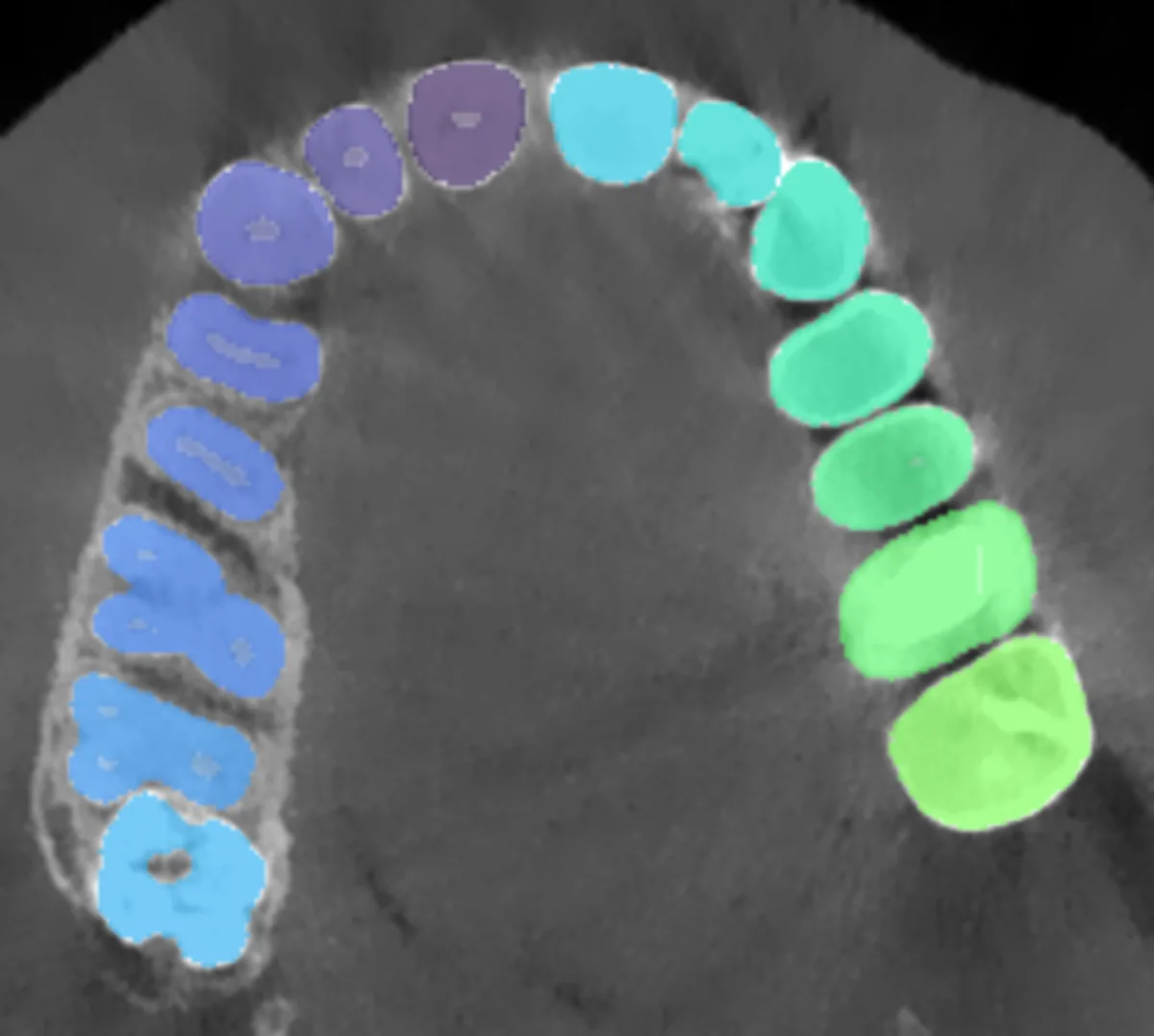
anatomical classes segmented in a single inference pass.
- Maxillary Right Central IncisorFDI 11
- Maxillary Right Lateral IncisorFDI 12
- Maxillary Right CanineFDI 13
- Maxillary Right First PremolarFDI 14
- Maxillary Right Second PremolarFDI 15
- Maxillary Right First MolarFDI 16
- Maxillary Right Second MolarFDI 17
- Maxillary Right Third MolarFDI 18
- Maxillary Left Central IncisorFDI 21
- Maxillary Left Lateral IncisorFDI 22
- Maxillary Left CanineFDI 23
- Maxillary Left First PremolarFDI 24
- Maxillary Left Second PremolarFDI 25
- Maxillary Left First MolarFDI 26
- Maxillary Left Second MolarFDI 27
- Maxillary Left Third MolarFDI 28
- Mandibular Left Central IncisorFDI 31
- Mandibular Left Lateral IncisorFDI 32
- Mandibular Left CanineFDI 33
- Mandibular Left First PremolarFDI 34
- Mandibular Left Second PremolarFDI 35
- Mandibular Left First MolarFDI 36
- Mandibular Left Second MolarFDI 37
- Mandibular Left Third MolarFDI 38
- Mandibular Right Central IncisorFDI 41
- Mandibular Right Lateral IncisorFDI 42
- Mandibular Right CanineFDI 43
- Mandibular Right First PremolarFDI 44
- Mandibular Right Second PremolarFDI 45
- Mandibular Right First MolarFDI 46
- Mandibular Right Second MolarFDI 47
- Mandibular Right Third MolarFDI 48
This is the first post in our Engineering Notes, so it is also the first time we have said much of anything in public. That was deliberate. For roughly two years we have been heads-down, building a production CBCT segmentation SDK to a standard we were willing to put our name on — and only now, with version 2.3.0 shipping today, does it feel honest to open the doors and start writing.
Why we stayed quiet
Medical imaging is an unforgiving place to ship software. A segmentation engine that runs inside someone else's regulated device has to be right, has to be reproducible across platforms, and has to keep its promises release after release. None of that is helped by talking early. So instead of a launch announcement two years ago, we spent the time on the parts nobody sees in a demo: a fully encapsulated public API, an encrypted and licence-bound model format, exploit-mitigation build hardening, a security dossier assessed against IEC 62443, ISO/IEC 27001, and the EU Cyber Resilience Act, and the same numerical envelope on Windows and Linux.
The result is the thing we actually wanted to build — a C++ library that links directly into your application and runs dental CBCT segmentation across more than 70 classes in-process on the workstation GPU, in less than a minute of inference on a single modest card, with no cloud, no container, and no service to operate. Getting there meant going deep where it counted — down to writing our own CUDA kernels where the off-the-shelf ones were not good enough.
What Engineering Notes is for
This is not a marketing channel. It is a place to write down what we learn building production AI for medical imaging: how the inference pipeline is put together, where ML systems spend their time and how we get it back, what reliability costs and why it is worth paying. Notes from the workbench, written by the people doing the work.
What's next
Version 2.3.0 is available now. Version 3 of the SDK targets September 15, 2026 — same public API, same regulatory posture, broader capability. And we hope to announce a few partnerships at the International Dental Show (IDS) next year. Stay tuned!
Thanks for reading. If you are building an imaging product and this sounds like a component you have been looking for, we would like to hear from you.